





Jennifer Linton on turning early insurance data into better customer outcomes
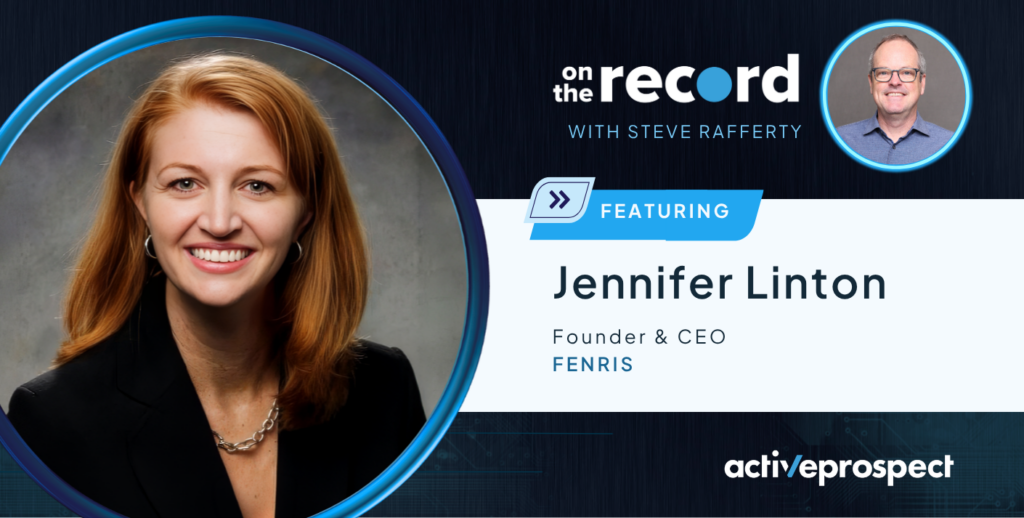
Jennifer Linton is an insurance technology leader, entrepreneur, and the CEO/Founder of Fenris. She leads the development of real-time data and analytics platforms that support millions of monthly insurance quoting workflows across auto, home, and commercial lines. Her background spans 15+ years in startup growth, corporate strategy, business development, and innovation.
SR: You’ve spent your career building data-driven businesses that challenge the status quo. How has that mindset shaped the way you think about improving the connection between insurers and consumers, especially at the very first point of their action?
JL:
Over the past two decades, whether building startups or working within large enterprises, I’ve observed how crucial data is in decision support.
Most of the insurance industry has focused on optimizing what happens after intake with better underwriting models, better pricing, better workflows. But if the data coming in at the start is wrong or incomplete, everything downstream is working off a flawed foundation, and that was where Fenris started in 2020 by building its capability to enrich and prefill any application for any insurance product.
Today, we’re at an inflection point. Predictive insights can now be applied as early as the initial ping and continue throughout the quote, sale, and policy lifecycle. This helps insurers and consumers connect more effectively by making the first interaction more informed, more accurate, and more reflective of real risk before the process even begins.
Imagine knowing, at the first touchpoint, whether a prospect could become your best customer. That changes everything downstream. At Fenris, we’re focused on eliminating the gap between intake and insight, to align with what will ultimately yield the best outcome.
Turning insight into action
- Audit where early workflow decisions are being made with incomplete information. Most organizations focus heavily on underwriting and pricing optimization while overlooking the quality of the data entering the process. Identify where intake, routing, prioritization, or follow-up decisions are happening before enough context is available.
- Move enrichment and predictive intelligence closer to the first interaction. Apply real-time data and predictive signals before quote or underwriting so teams can make better decisions earlier, rather than correcting issues downstream after time and resources have already been spent.
- Use first-touch signals to drive segmentation and workflow orchestration. The earliest customer interactions often contain enough information to distinguish high-fit opportunities from low-fit ones. Build workflows that use those signals to influence routing, engagement strategy, and next-best actions from the start.
SR: With Fenris focused on real-time data and predictive intelligence, how should insurers rethink the role of data enrichment in creating more meaningful and effective customer connections, and not just faster ones?
JL:
There’s been a longstanding push to reduce friction in insurance workflows, often measured by how quickly an agent or consumer can move through a process. But speed alone isn’t enough. The real value comes from validating and enriching the right information at the right time. If you rely on defaults or skip meaningful data fields, you risk undermining both your business and the customer’s experience.
The key is to use real-time predictive intelligence to identify high-potential customers early, then create an optimized journey, and enrich with the necessary data. This isn’t just about moving faster, it’s about making every interaction count. At Fenris, we deliver this through APIs and emerging use cases like agentic workflows, where bots or digital agents can dynamically request only the data that matters.
Turning insight into action
- Validate critical customer data before advancing the workflow. Identify where inaccurate or missing information is creating downstream friction in quoting, underwriting, or servicing, and prioritize real-time enrichment at those points.
- Personalize the workflow based on predicted customer value and intent. Use predictive signals to determine which prospects require additional verification, different routing, or higher-touch engagement instead of applying the same process to every submission.
- Design workflows that request only the data necessary for the next decision. Reduce unnecessary questions and leverage APIs or intelligent orchestration to dynamically enrich information as needed throughout the customer journey.
SR: There’s a growing emphasis on reducing friction in quoting and underwriting workflows. Where do you see the biggest disconnect today between the data insurers have and the decisions they need to make in real time?
JL:
The biggest disconnect is in the distance between the data and the decisions. Often, data is applied at underwriting that, if known earlier, would have completely changed the outcome for the better. When there is no upfront segmentation, every lead is pushed through the process, regardless of fit. This is inefficient and costly.
There are three main challenges:
- Data silos make it hard to connect insights from one system to another.
- Models and data sources require constant upkeep; what works today may be outdated tomorrow as new products, campaigns, or markets emerge.
- Traditional workflows front-load the process with questions and only apply data at the “moment of truth”, the rate call or indicative quote.
To truly enable real-time decisioning, insurers need to break down these barriers and bring predictive intelligence to the very start of the customer journey.
Turning insight into action
- Identify decisions that are currently happening too late in the process. Review where underwriting, routing, or qualification insights are only being applied at quote or bind, and determine how those signals could improve earlier workflow decisions.
- Break down operational silos between data, distribution, and underwriting teams. Ensure that insights generated in one system can be used across intake, routing, quoting, and servicing workflows instead of remaining isolated.
- Continuously evaluate model and data performance against changing market conditions. Establish a process for retraining models, validating data sources, and adjusting segmentation strategies as products, channels, and customer behavior evolve.
SR: With ActiveProspect’s acquisition of VMS and Fenris already adding predictive lead scoring, what new opportunities does this partnership unlock for the industry, and where do you see it making the biggest difference?
JL:
Fenris has been a partner of both VMS and ActiveProspect, so we see clearly the potential from bringing these two capabilities together. Every partnership is about scale and synergy.
With VMS, Fenris’s machine learning platform was enabling them to serve scores in the education and home services verticals, accelerating time to value and reducing the cost of maintaining in-house solutions.
ActiveProspect has been a leader in the lead gen space for a while, across almost every possible vertical exemplifying their strengths in consent, compliance, and lead transparency. As part of our partnership there, Fenris has been delivering its prefill data to enrich leads.
All together, we see lead buyers and publishers will benefit post Active Prospect’s acquisition of VMS, in a way that prioritizes results based on revenue potential, capacity, and predicted outcomes, transforming how leads are purchased, routed, and acted upon.
Turning insight into action
- Prioritize leads based on predicted business outcomes, not just volume. Shift from evaluating leads solely on cost or speed to using predictive intelligence that identifies which opportunities are most likely to convert or generate long-term value.
- Align lead routing with operational capacity and appetite. Use predictive scoring and consent-driven data to direct leads toward the right buyer, team, or workflow based on fit, performance potential, and real-time business constraints.
- Integrate compliance, enrichment, and predictive intelligence into a unified workflow. Reduce fragmentation between lead acquisition, validation, and decisioning systems so teams can act on more complete and trustworthy information from the start.
SR: In an environment where AI is accelerating everything, how do you decide when sooner is better than better, and when precision still needs to win?
JL:
“Sooner is better than better,” is a reminder that in fast-moving markets, waiting for perfection can mean missing the moment. You need to deliver value quickly.
I have to give credit to my Board member, Larry, former CEO of FICO, for making me see the value in shipping products fast, even if it’s not perfect, because models and data will continue to improve over time.
At Fenris, we balance speed with our three pillars for machine learning:
- Transparency
- Explainability
- Fairness
If a model meets these criteria and delivers value, we deploy it, knowing it will learn and adapt as more data flows in. With over 100 million outcomes informing our algorithms, we’ve seen firsthand how rapid iteration leads to better results. When the data is right, you don’t have to choose between speed and precision, you can have both. That’s the future we’re building.
Turning insight into action
- Launch models that deliver measurable value, even if they are not fully optimized. Focus on transparency, explainability, and business impact first, then improve performance over time through iteration and additional outcomes data.
- Build feedback loops that allow models to continuously learn and improve. Capture downstream outcomes such as bind, conversion, retention, or churn so predictive systems can adapt to changing customer and market behavior.
- Define governance standards before deploying AI into production workflows. Establish clear expectations around fairness, explainability, and monitoring so teams can move quickly without sacrificing trust or accountability.