






The complete TCPA express written consent checklist
TL;DR
• Prior express written consent (PEWC) is a TCPA requirement for many telemarketing calls and text messages sent using an autodialer, prerecorded voice, or similar automated technology.
• TCPA compliance matters because businesses that contact consumers without valid prior express written consent can face statutory damages of $500–$1,500 per violation, class action lawsuits, and FCC enforcement.
• Valid express written consent requires clear disclosures, identification of the seller, documentation of consent, and notice that consent is not a condition of purchase.
• Consumers can revoke consent at any time using reasonable methods, making consent record retention and consent management critical compliance requirements.
• Businesses should maintain auditable proof of consent, including when, where, and how consent was obtained, to help defend against TCPA claims and regulatory scrutiny.
Overview
Talking to your customers is key. But with great power comes great responsibility. You have to follow a number of rules to make sure you’re communicating with your customers in a way that’s safe and respects their privacy.
One of the big ones is the Telephone Consumer Protection Act (TCPA). The TCPA is all about telemarketing, and it covers things like automated calls and text messages. To make sure you’re playing by the rules, you need to get prior express written consent (PEWC) for TCPA from your customers before you can start making these kinds of marketing communications.
In this post, we’re going to break down what express written consent is, why it’s important, and how you can get and manage it the right way through TCPA compliance software. Stick to the plan, and you’ll be in good shape to keep your customers happy and your business in the clear.
What is prior express written consent (PEWC) for TCPA?
Remember the days when your phone would ring with calls from numbers you didn’t recognize, maybe during dinner or even in the middle of the night? Or that time you received an unsolicited text message from a company you had never heard of? If you answered yes to either of these questions, you may have been on the receiving end of a marketing message sent in violation of the TCPA.
The TCPA, which was enacted in 1991 by the Federal Communications Commission (FCC), was designed to protect consumers from unwanted phone calls and fax messages by placing restrictions on businesses. Later court decisions then began to consider text messages the same as phone calls and therefore also subject to TCPA consent requirements. Failure to comply with these restrictions can lead to severe legal repercussions for companies, including fines and lawsuits.
The cornerstone of TCPA compliance is the principle of “express written consent.” Here’s the express written consent’s definition: “A signed, written agreement between the consumer and seller, which states that the consumer agrees to be contacted by this seller and includes the telephone number to which the calls may be placed.”
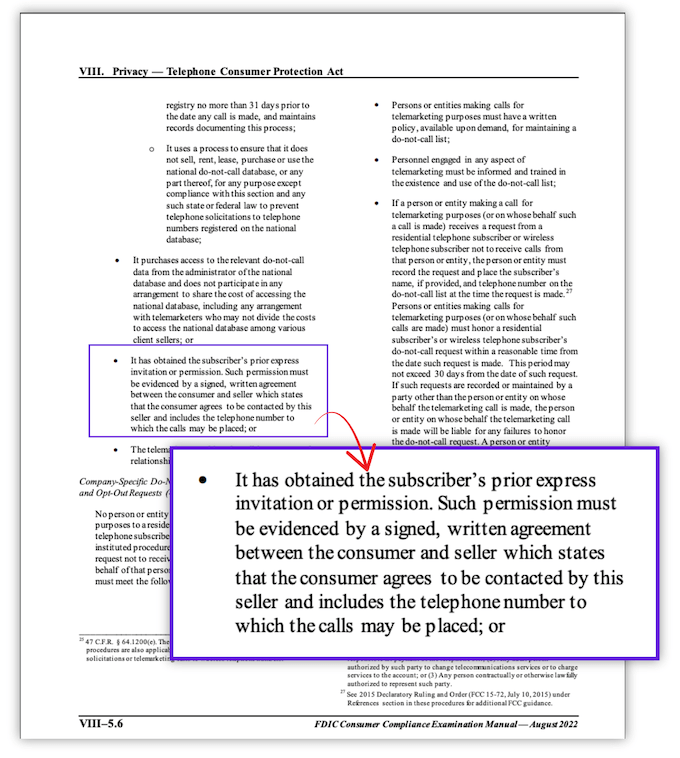
This permission must specify the phone number to be called and requires obtaining the recipient’s written or electronic signature. This could be a signed document or pressing of a webform button with suitable language compliant with the E-SIGN Act and indicating a selection and agreement is being provided. It is also necessary to disclose that giving consent is not a condition of purchase.
TCPA prior express written consent requirements
As of today, in order to comply with the TCPA, consent must:
- Be documented. This means the consumer’s agreement must be captured in writing, either on paper or in an electronic format that can be stored and retrieved.
- Be clear and conspicuous. The consumer must be able to easily understand that they are giving their consent to be contacted.
- Clearly state that the consumer has the right to revoke their consent. You must make it undeniably clear that the consumer has the right to change their mind and withdraw their consent at any time and with any reasonable means.
- Be obtained before calling or sending the text message. You, as a business, need to get the green light from the consumer before you call (using an ATDS automatic telephone dialing system) or hit send on any marketing text messages.
Businesses must comply with these regulations to avoid significant penalties and legal challenges. Therefore, a system to capture and document prior express written consent is a must. This system should include:
- A method to record when and how consent was given.
- A method to securely store the consent records, using systems that include enhanced monitoring and data breach detection capabilities.
- A way to easily retrieve the consent records as needed.
Remember, securing consent is a powerful way to minimize the risk of TCPA infractions and safeguard your business.
A checklist to help you obtain and manage prior express written consent for marketing outreach
ActiveProspect offers an easy way to help you obtain and store proof of consent to contact: TrustedForm, the ultimate compliance solution for documenting TCPA consent on digital lead capture forms.
First, TrustedForm Certify helps you capture proof of consent by documenting exactly when and where consent was obtained throughout a lead capture event, with an easily accessible session replay.
Then, you can store and access this documentation of consent through TrustedForm Retain, which holds certificates and makes them available for up to five years.
Then, use TrustedForm Verify to help identify if prior express written consent disclosures were presented digitally.

To help you meet the regulatory requirements, consider implementing the following best practices:
- Prominently disclose the consent request: Ensure that the request for consent is easy to spot, above the submit button and not buried in fine print. Use language that’s crystal clear, avoiding jargon or confusion, and present the request in a way that stands out from other information.
- Provide a clear and concise explanation: Explain what kind of messages a person will receive if they opt in. Will they get promotional offers, updates, or reminders? And if so, how often can they expect to hear from you?
- Offer an easy opt-out mechanism: Make sure your customers can easily opt out of your messages. Offer clear instructions on how to do so, such as by replying with “STOP” or “UNSUBSCRIBE” or by visiting a specific webpage.
- Maintain thorough records: Keep meticulous logs and records of all consent you’ve gathered. These should include the date and time of consent, the specific communication channel used (be it SMS or phone call), the content of the consent request, and the consumer’s response. Hang onto these records for a reasonable period as evidence of your compliance.
- Train your staff: Make sure your staff who engage with customers are well-versed in TCPA regulations and the importance of securing prior express written consent. Equip them with the right procedures for requesting and documenting consent to avoid any missteps.
TCPA prior express written consent language
To be valid, TCPA prior express written consent language must clearly include the following elements:
- Clear and conspicuous disclosure. The consumer must be clearly informed that:
- They are agreeing to receive telemarketing calls or texts.
- These messages may be sent using an automatic telephone dialing system (ATDS) or pre-recorded voice (if used).
- Identification of the seller. The consent language must specify the business or seller(s) that will be making the calls or sending messages.
- No purchase condition. The language must state that consent is not a condition of purchase.
- Signature. A signature is required, but this can be electronic (e.g., checking a box, clicking a button, typing a name, etc.), as long as it also complies with the E-SIGN Act.
Common mistakes that lead to TCPA prior express written consent language non-compliance
- Using vague language like “may be contacted” without specifying autodialers or pre-recorded messages.
- Not naming the seller or linking to an up-to-date partner list.
- Not using a clear webform call to action (CTA) button language indicating agreement, such as “By clicking, I agree”.
- Not presenting the disclosures language above the CTA button. Disclosure language must be easy to read, have the appropriate font size, and should have a color that reasonably contrasts the background color.
- Collecting consent in a passive or ambiguous way.
- Not keeping into consideration all of the above for smaller screens and mobile device use as well.
Why you need to obtain prior express written consent for marketing calls and texts
Failing to comply with the TCPA can lead to significant legal and financial consequences. Here are the main repercussions:
- Statutory damages: Violators can be held liable for statutory damages. The TCPA allows individuals to sue for $500 per violation. If the court finds that the violations were willful or knowing, it can triple the amount to $1,500 per violation.
- Class action lawsuits: Non-compliance can result in class action lawsuits, where a group of consumers who have received unsolicited calls or messages can sue collectively. This can multiply the potential damages exponentially, leading to multi-million dollar settlements or judgments.
- Regulatory fines: The FCC can impose fines for TCPA violations. These fines can be substantial, particularly for large-scale or egregious violations.
- Injunctive relief: Courts may issue injunctions to prevent ongoing or future violations, which can include orders to cease certain practices or implement compliance measures.
- Reputational damage: Beyond financial penalties, non-compliance can lead to negative publicity and damage to a company’s reputation, impacting customer trust and business relationships.
- Operational impact: Legal actions and regulatory scrutiny can disrupt business operations, requiring significant time and resources to address the issues and implement corrective measures.
To avoid these consequences, businesses should ensure they have robust compliance programs in place, including obtaining proper consent before making calls or sending messages, maintaining accurate records, and regularly training employees on TCPA requirements.
FAQs
1. What does express written consent mean?
Express written consent is a consumer’s clear agreement, provided in writing or through a compliant electronic signature process, allowing a business to contact them for specific purposes. Under the TCPA, prior express written consent is typically required before a business can send certain marketing text messages or place telemarketing calls using an automatic telephone dialing system (ATDS), prerecorded voice, or artificial voice technology.
To be valid, express written consent must clearly disclose the nature of the communications, identify the seller, and state that consent is not a condition of purchase. Businesses should also retain records showing when and how consent was obtained.
2. What is the latest update for the revocation of consent rules?
Just days before it was supposed to go into effect, the FCC delayed the enforcement of a piece of the revocation of consent rule until April 11, 2026.
However, other key parts of the regulation still went live on April 11, 2025. These include providing clear opt-out instructions in every marketing text and honoring all internal Do Not Call (DNC) requests within 10 business days.
Then, on January 6, 2026, the FCC pushed back the “revocation-applies-to-everything” (“revoke all”) requirement again.
Right now, you should assume you must accept and process revocations broadly across “reasonable” channels (texts, IVR opt-outs, web forms you provide, etc.)—but the specific “one opt-out = stop all categories/messages across the business” piece is on hold until January 31, 2027.
3. Are there exceptions to the prior express written consent requirement?
There are exceptions to the prior express written consent requirement under the TCPA. These exceptions generally apply to certain types of calls and messages that are not considered telemarketing or do not use automated systems.
However, before relying on one of these potential exemptions, seek qualified TCPA legal compliance advice about your calling/texting campaigns and technology being used.
Below are some potential TCPA exceptions:
- Non-telemarketing calls. Calls or messages that do not involve marketing or promoting a product or service are typically exempt. Examples: Informational calls (such as appointment reminders or delivery notifications), calls from schools, healthcare providers, or emergency alerts.
- Calls to existing customers (Established Business Relationship). Businesses can call individuals with whom they have an established business relationship (EBR) without prior express written consent, though the scope of this exception is limited. For more information about EBR and the defined time period allowances (3 months or 18 months), see the FTC’s Telemarketing Sales Rules (TSR) and related FTC Q&A guidance. However, this does not exempt calls using an automated telephone dialing system (ATDS) or prerecorded messages, which may still require consent.
- Purely manual calls. If the call or text message is manually dialed without the use of an autodialer or prerecorded message, prior express written consent may not be required.
- Non-commercial messages. Communications that are purely informational or transactional and do not include any promotional content may be exempt. Examples: Fraud alerts or data breach notifications, flight cancellations or schedule changes.
- Emergency purposes. Calls or texts made for emergency purposes are exempt. Examples: Alerts regarding natural disasters, health emergencies, or public safety issues.
- Consent for specific categories. In certain cases, prior express consent (not written) is sufficient. For example, debt collection calls made on behalf of a creditor to a consumer’s mobile phone.
- Healthcare messages. Calls or texts from healthcare providers covered under the Health Insurance Portability and Accountability Act (HIPAA) are exempt, provided they are informational and related to patient care, which also applies when sharing secure patient documentation, such as medical forms.
- Key considerations. Telemarketing vs. informational: One of the primary factors determining whether prior express written consent is required is whether the communication is for telemarketing purposes. State laws: Some states have stricter consent requirements than the federal TCPA rules, which may eliminate these exceptions.
For businesses, it is crucial to carefully evaluate the purpose and method of their communications to ensure compliance with the TCPA and its exceptions.
4. What is a TCPA express written consent example?
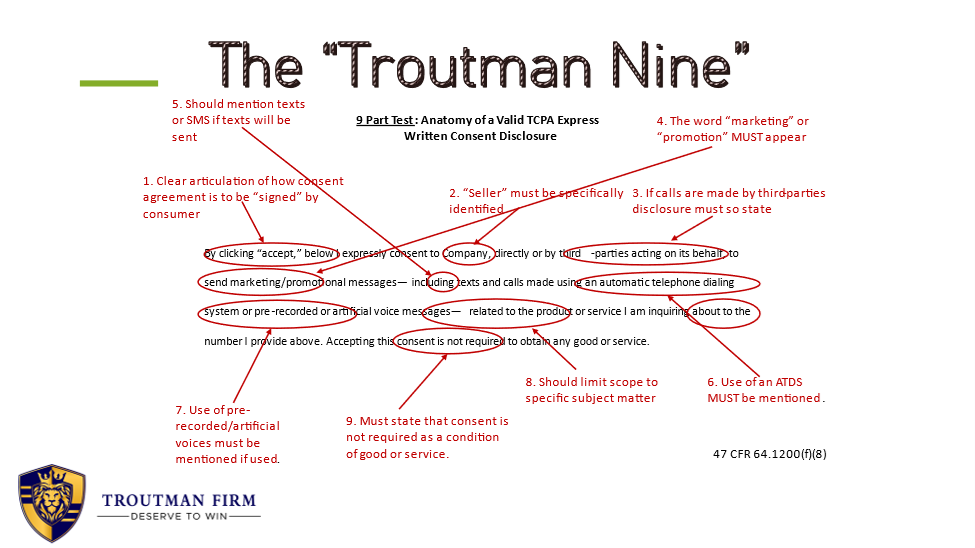
Eric J. Troutman of the Troutman Amin, LLP and TCPAWorld.com offers a robust TCPA PEWC copy example with his “Troutman Nine” template.
5. Does express written consent expire under the TCPA?
Under the TCPA, express written consent does not technically “expire” on a fixed timeline – but it can be revoked by the consumer at any time using a reasonable method.
While there’s no automatic expiration date, consent becomes invalid if:
- The consumer revokes consent, which they’re allowed to do at any time.
- The purpose or nature of the communication changes (e.g., new product or different campaign not covered by the original consent).
- The consent was collected improperly or lacks key disclosures.
Treat express written consent as valid until revoked, but track it carefully, document when and how it was obtained, and ensure easy opt-out mechanisms to stay compliant.
6. When is express written consent required under the TCPA?
Under the TCPA, prior express written consent (PEWC) is required when you’re sending advertising/telemarketing messages using automation—especially for robocalls and robotexts:
- Marketing/telemarketing calls or texts to a wireless number when delivered using an autodialer (ATDS) and/or an artificial/prerecorded voice require PEWC.
- Prerecorded/artificial voice telemarketing calls to residential landlines require PEWC.
- Telemarketing to numbers on the National Do Not Call Registry generally requires prior express invitation or permission, which is typically captured as a signed written agreement (i.e., PEWC-style documentation).
7. How do you write a prior express written consent form?
A prior express written consent form should use clear, conspicuous language that informs consumers exactly what they are agreeing to receive. The form should:
- Identify the company or seller that will contact the consumer.
- Explain that the consumer agrees to receive marketing calls and/or text messages.
- Disclose whether calls may use an automatic telephone dialing system (ATDS), prerecorded voice, or artificial voice technology.
- State that consent is not a condition of purchasing goods or services.
- Include a valid signature mechanism, such as a checkbox, electronic signature, button click, or other E-SIGN Act-compliant method.
- Provide a way to document and retain proof of consent.
Businesses should consult qualified legal counsel before implementing consent language to help maintain that it complies with applicable TCPA requirements, FCC regulations, and state laws.
Final thoughts
TCPA is not a joke and making sure you’re properly getting prior express written consent before contacting consumers is going to protect you from getting involved in nasty and costly lawsuits.
By adopting the best practices listed above and utilizing a dependable consent management system like TrustedForm, you can successfully obtain and oversee consumer consent, reducing the likelihood of TCPA infractions and fostering trust with your customers.

DISCLAIMER: This page and all related links are provided for general informational and educational purposes only and are not legal advice. ActiveProspect does not warrant or guarantee this information will provide you with legal protection or compliance. Please consult with your legal counsel for legal and compliance advice. You are responsible for using any ActiveProspect Services in a legally compliant manner pursuant to ActiveProspect’s Terms of Service. Any quotes contained herein belong to the person(s) quoted and do not necessarily represent the views and/or opinions of ActiveProspect.