
Designing a better lead ecosystem for 2026: ActiveProspect’s 2025 recap + what’s next
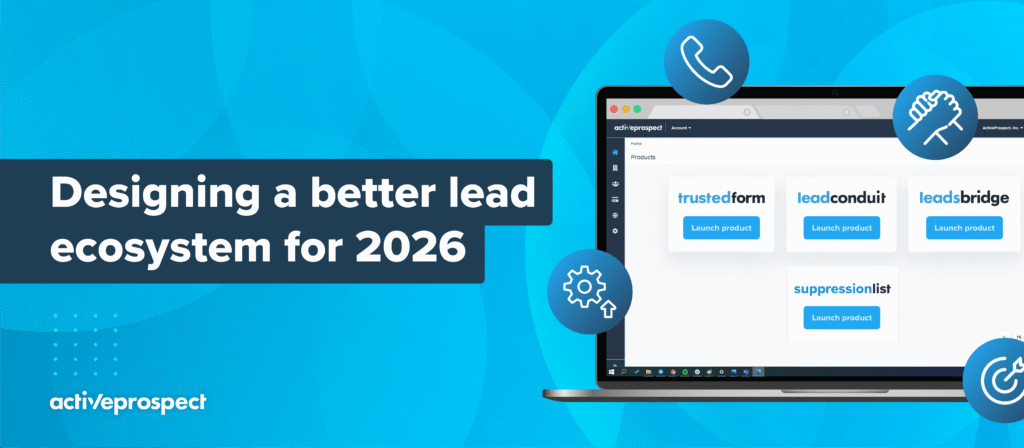
ActiveProspect kicked off its first product-specific webinar of the year with a clear message: The lead generation ecosystem is evolving fast—and trust, transparency, and performance have to evolve with it.
This session walked through three things customers care about most right now:
- What ActiveProspect launched in 2025
- How those launches connect into one platform vision
- What’s coming in 2026, including a major expansion beyond web leads into inbound calls
Along the way, the team also addressed a major piece of news: ActiveProspect’s acquisition of Verisk Marketing Solutions (VMS)—a move that signals bigger ambitions for how data, identity, and compliance will power lead acquisition in the years ahead.
Below is a recap of the biggest takeaways—and why they matter for lead buyers, sellers, and anyone building a scalable lead program in 2026.
Key takeaways
- ActiveProspect acquired Verisk Marketing Solutions to combine a software platform + high-quality data—more capability, better ROI, and simpler offerings over time.
- ActiveProspect is building one connected platform (not separate tools) focused on trust, transparency, and performance across the full lead lifecycle.
- TrustedForm is the foundation—capturing independently verifiable lead event data that powers compliance and optimization.
- Bot detection is a top lead-quality pain; new bot detection signals in Insights help identify non-human leads that skew reporting and create TCPA risk.
- Optimization Hub turns signals into action with recommendations to improve lead quality (starting heavily with bot-related guidance).
- Vendor Reports improve partner accountability with clearer, on-demand vendor-level visibility (reducing spreadsheet reconciliation and disputes).
- LeadConduit is the execution engine that uses trusted inputs (consent + quality signals) to filter, route, and deliver leads for better outcomes.
- Closed-loop reporting is expanding via conversion/disposition feedback (Salesforce + LeadPerfection first; HubSpot was the top next request).
- Free buyer accounts strengthen buyer–seller collaboration by enabling shared reporting and easier partner setup from day one.
- 2026 preview: Expansion into calls—including “in-call consent” concepts to capture express written consent and bring call leads into LeadConduit-like workflows.
Now let’s unpack the topics presented above.
A major announcement: ActiveProspect acquires Verisk Marketing Solutions
ActiveProspect’s Founder and CEO Steve Rafferty opened with context on the newly announced acquisition of Verisk Marketing Solutions (VMS), announced on January 8.
Who is VMS?
VMS was a division of Verisk Analytics, primarily made up of two well-known brands:
- Jornaya, a long-time compliance competitor in the TCPA space.
- Infutor, a consumer identity management provider offering data for verification, enrichment, and identity scoring.
Steve emphasized that while ActiveProspect and Jornaya competed for years, the two companies ultimately shared a mission: Bringing trust and transparency to online lead generation. But he also highlighted the key difference:
- VMS is fundamentally a data company.
- ActiveProspect is fundamentally a software platform company.
That distinction is what makes the combination compelling.
Why it matters
Steve framed the acquisition as a way to accelerate what customers want most: Better inputs, smarter decisioning, and fewer wasted dollars.
At a high level, he described three outcomes the acquisition should drive over time:
- A more powerful platform: Bringing VMS data into the ActiveProspect platform could help customers better identify leads, price them appropriately, and improve ROI.
- More innovation: Two experienced teams, two sets of technology, and shared learnings should speed up delivery and improve outcomes.
- A higher standard of performance: Greater scale and expertise should improve reliability and customer experience—and ideally simplify offerings for the ecosystem.

One connected platform, not a collection of tools
After the acquisition update, the product team turned to the main theme of the webinar: Designing a better lead ecosystem for 2026. The starting point was a clear platform philosophy.
As Product Manager Nicki Baker explained, ActiveProspect isn’t positioning its products as separate tools—it’s building a single platform experience designed to bring trust, transparency, and performance together across the lead lifecycle. The goal is a more streamlined experience where customers can use multiple capabilities without stitching together disconnected workflows.
TrustedForm remains the foundation: Trust first, then performance
Technical Product Manager Christopher Williams described TrustedForm as more than a compliance tool—it’s infrastructure. Because a TrustedForm Certificate captures the lead event in detail, it becomes a foundation for:
- Documenting proof of how the lead was generated
- Verifying compliance requirements
- Unlocking optimization, filtering, and routing decisions
- Powering insights that go beyond “did we get a lead?” into “what’s behind this lead?”
In other words: Once you establish trust, you can begin making smarter decisions.
The biggest lead quality challenge in 2025: Bots (and what to do about them)
According to Christopher, bots are now a major industry problem, and if you don’t think you’re dealing with them, you may just not be seeing them yet.
Why bots create a compliance and performance crisis
The team highlighted a key point that’s especially important for 2026:
- Bot-generated leads can look legitimate
- They can use real consumer information
- But the consumer did not actually fill out the form
That creates two major risks:
- Consent becomes invalid: If a bot completed the form, the consumer never meaningfully consented. That means companies may be acting on “fabricated consent,” increasing TCPA exposure.
- Optimization becomes unreliable: Bot leads skew reporting, pollute conversion data, and can lead teams to make the wrong decisions about channels, vendors, and spend.
2025 launch: Bot Detection inside TrustedForm Insights
To address this, ActiveProspect introduced bot detection signals via the TrustedForm Insights product—designed to help customers identify “obvious” indicators of automation or scripted submissions.
But Christopher also made an important point: Insights is only useful if teams know what to do with it—which led into the next major launch.

From insights to action: Optimization Hub
A common pain customers shared with ActiveProspect is simple: “You see more lead data than anyone—tell us what we should do.”
To meet that need, ActiveProspect introduced Optimization Hub, which turns lead quality signals into recommendations customers can act on.
Think of it as guided optimization inside the platform:
- Identify issues impacting lead quality (starting heavily with bots)
- Recommend product features, settings, or adjustments
- Reduce guesswork by operationalizing what ActiveProspect has learned since 2004
Today, it’s early. Over time, the plan is to expand recommendations beyond bot-related guidance into more categories of lead quality and performance improvement.
Vendor-level visibility: Vendor Reports bring accountability to partner networks
Lead quality isn’t only a lead-level issue. For most buyers, the real operational challenge is vendor networks.
To solve that, ActiveProspect launched Vendor Reports in 2025. The goal is to create a shared source of truth that makes it easier to:
- Compare vendors using consistent metrics
- Spot issues tied to specific sources
- Reduce spreadsheet reconciliation
- Strengthen accountability and partnership performance
LeadConduit: The engine that turns trusted inputs into outcomes
If TrustedForm is the foundation, LeadConduit is the connective tissue.
Leandro Estrella, Associate Product Manager, described LeadConduit’s role as the engine that takes trusted data—consent signals, quality indicators, enrichment data—and turns them into action:
- Filtering
- Routing
- Delivery logic
- Decisioning tied to business outcomes
The point isn’t simply moving leads faster. It’s ensuring every lead is routed and acted on appropriately based on trust, quality, and performance goals.

Closing the loop: Conversion and disposition feedback
One of the biggest themes of the webinar was moving beyond “delivered” as the finish line. Lead buyers ultimately need to know:
- Which leads became opportunities?
- Which converted?
- Which vendors or channels produced revenue?
That’s why ActiveProspect introduced conversion and disposition feedback integrations starting with Salesforce and LeadPerfection. This enables:
- Closed-loop reporting inside lead operations
- Optimization based on real outcomes (not just CPL or acceptance rate)
- Better vendor evaluation
- Real-time performance feedback that can be shared with sellers
Free buyer accounts: Building a network, not just workflows
ActiveProspect also launched free buyer accounts and a “buyer step” as part of a bigger strategy: Making it easier for sellers to bring partners into a shared ecosystem.
The idea is to make collaboration simpler from day one:
- Sellers invite buyers easily
- Shared reporting is created automatically
- Buyers can configure what they need
- Both parties work from a shared view of performance
This is a subtle but important shift: ActiveProspect is investing not just in tools, but in network features that reduce friction between buyers and sellers.
Platform experience updates: Flow Editor, Company Profiles, unified UX
Behind the scenes, the team also invested heavily in platform usability and scalability.
Nicki highlighted updates like:
- New Flow Editor
- Company Profiles
- Unified app experience
All three support the same goal: Making it easier for customers to scale and for buyers/sellers to work together inside ActiveProspect.
Company Profiles in particular were positioned as a trust-building layer: Surfacing key partner context, improving onboarding, and enabling personalization as network features expand in 2026.
2026 preview: Expanding beyond web leads into calls
One of the most significant roadmap themes was expansion beyond form-based leads into inbound calls.
Product Manager Christian Goss explained why this is a natural evolution: The platform has become strong around web leads, but many customers operate in a blended ecosystem—web leads and calls.
The vision: Bring call-based leads into the same workflows customers use for web leads. That means enabling customers to:
- Capture call leads
- Document consent
- Enrich and route calls inside LeadConduit
- Apply suppression, logic, and decisioning the same way they do with forms
In-call consent: Turning a call into express written consent.
Christian also gave a preview of how “in-call consent” may work:
- A call center (or AI intake) triggers a text message
- The consumer receives a link to a page
- Consent is captured via a two-click flow (low friction)
- The business can then follow up by call/text with express written consent
The team confirmed they are building a waitlist and recruiting interest for beta participation via customer reps.

Where ActiveProspect is heading: A more trusted, connected lead ecosystem
The final roadmap themes for 2026 were summarized as:
- Expanding into calls
- Deeper partner collaboration
- Growing across social lead channels
- Enabling more flexible seller distribution
But the most consistent thread was this: ActiveProspect is moving from a set of products into a unified platform designed to help the ecosystem operate with higher trust, transparency, and performance.
And layered on top of that platform trajectory is the acquisition of VMS—bringing the potential for richer data inputs that can improve:
- Lead identification and pricing
- Filtering and enrichment
- Quality scoring and performance decisioning
- Possibly even bot detection capabilities over time
As Steve put it, customers want simplification. The platform direction—and the acquisition—are both steps toward building that simpler, stronger foundation for growth.
Conclusion
As lead generation moves into 2026, the message from this webinar was clear: Growth without trust is no longer sustainable. Between rising compliance risk, increasingly sophisticated fraud, fragmented vendor networks, and expanding acquisition channels like inbound calls, lead programs need more than point solutions—they need a connected system that turns trusted inputs into measurable outcomes.
ActiveProspect’s 2025 launches, platform investments, and acquisition of Verisk Marketing Solutions all point toward the same goal: Building a lead ecosystem where buyers and sellers can operate with confidence, act on real insights, and scale without unnecessary risk.
For teams planning their 2026 strategies now, the takeaway is simple—lead generation success will depend less on volume alone, and more on how well trust, transparency, and performance are designed into every step of the journey. And ActiveProspect is determined to help you do that.