






The invisible 1%: How bots quietly drain lead buying budgets

TL;DR
- Bot fraud often blends into normal lead flow, but even a sub-1% bot rate creates major waste at scale.
- ActiveProspect data shows average weekly bot rates of 1% to 6% over the last six months, affecting roughly 17,000 to 100,000 leads.
- Bot-generated leads do more than waste spend; they pollute CRM data, distort performance signals, waste sales effort, and increase TCPA risk.
- Bot activity tends to follow patterns, including timing shifts, domain concentration, and vulnerability in high-intent verticals.
- The key to reducing bot-related costs is earlier visibility: Buyers need better signals at intake so fraud can be identified before it affects routing, reporting, and ROI.
Overview
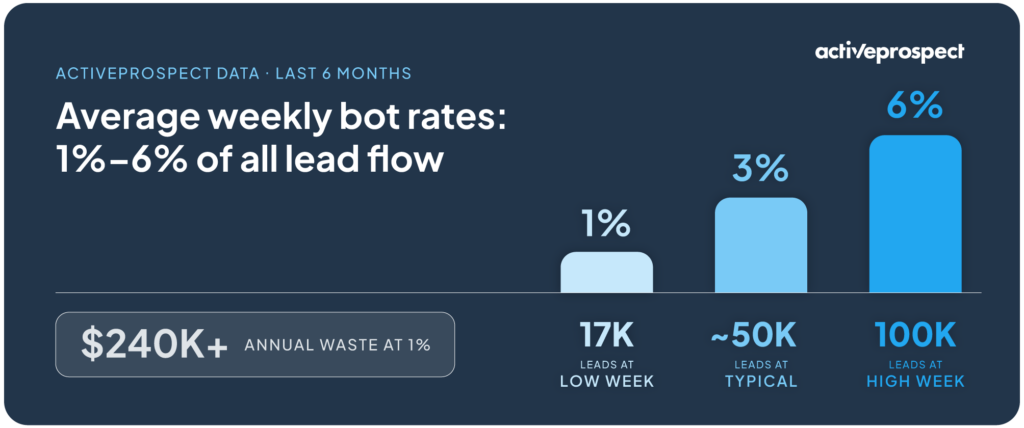
Bot fraud is easy to underestimate because it rarely looks dramatic. It often shows up as quiet, persistent non-human activity mixed into otherwise normal lead flow. ActiveProspect data shows that over the last six months, average weekly bot rates ranged from 1% to 6%, representing roughly 17,000 to 100,000 leads. That makes clear that bot traffic is not just a rare anomaly, it is an ongoing operational risk.
The risk is also often more concentrated than buyers realize. Among lead buyers purchasing more than 2,000 leads in the last six months, almost half retained leads from a source with a bot rate above 10%, 1 in 4 from a source above 50%, and 1 in 6 from a source above 90%.
Fraud shows up in patterns like timing shifts, domain concentration, and high-intent verticals. Better visibility is essential to protecting lead buying performance.
Bot fraud doesn’t have to be obvious to be expensive
When buyers think about bot fraud, they usually picture something blatant:
- A sudden spike in lead volume
- A campaign that breaks overnight
- Form fills with fake names, scrambled email addresses, or clearly invalid phone numbers
In other words, fraud that announces itself. But that is not how modern bot traffic usually works.
Today’s bots are often quiet, persistent, and intentionally built to blend in. They do not need to flood a system to do damage. They do not need to make up the majority of your lead flow. In many cases, even a bot rate under 1% can create a meaningful financial problem, especially at scale.
That is what makes this issue so easy to miss.
A sub-1% bot rate sounds harmless when viewed as a percentage. But low percentages can hide the real impact.
If you are buying 200,000 leads per month, even 1% represents 2,000 leads. At $10 per lead, that is $20,000 in spend going toward fraudulent or non-human activity every month, or $240,000 wasted over the course of a year. And that is before you account for the costs that come after the lead is delivered.
ActiveProspect data reinforces just how significant this problem can become. Over the last six months, average weekly bot rates have ranged from 1% to 6% (17k – 100k total leads). Those numbers make one thing clear: Bot fraud does not have to be dramatic to be expensive.
Bot fraud doesn’t just waste budget, it poisons performance signals
The direct cost of buying bot-generated leads is only part of the problem.
When a bot-generated lead enters your system, it does not stop being costly after the purchase. It keeps moving through your workflow, creating downstream consequences that affect performance, reporting, and strategy.
1% of a large lead flow can still mean thousands of fake conversations, fake records, and fake signals. Every one of those leads has the potential to trigger real cost:
- It pollutes your CRM with bad data, making data hygiene harder and reducing trust in your records.
- It wastes sales and call center time when teams follow up on leads that were never connected to a person who consented to be contacted.
- It can distort the way buyers evaluate traffic sources, campaigns, and partners.
- It can increase TCPA risk, since every bot-generated lead that enters your funnel creates the possibility of outreach without valid consent, opening the door to compliance exposure and additional wasted spend.
If bot-generated leads are mixed into otherwise normal lead flow, they can influence performance metrics in subtle ways. They may make a source look better or worse than it actually is. They may mask genuine quality issues. They may lead teams to optimize toward the wrong placements, the wrong partners, or the wrong buying strategies.
In that sense, bot fraud is not just a budget leak. It is a visibility problem.
And when buyers cannot clearly see where non-human traffic is entering the funnel, fraud starts to look like randomness or bad luck instead of what it really is: Systemic exposure.
Fraud is not random, it follows patterns
Bot activity is rarely static. It changes over time. It reacts to campaign volume, launch cycles, and defensive measures. That means the absence of a dramatic spike does not mean the absence of fraud. In fact, some of the most costly fraud patterns are the ones that quietly rise and fall while overall lead volume remains steady.
Time patterns
A campaign can appear stable on the surface while bot rates move underneath it. Fraud adapts. It can increase during periods of high demand, follow predictable traffic patterns, or shift as defenses improve. That makes it harder to detect with traditional monitoring focused mainly on volume, conversion rate, or delivery speed.
The result is a false sense of security. If lead counts look healthy, teams may assume the traffic is healthy too. But volume alone does not reveal whether the activity behind those leads is human.
Domain concentration
Bot activity is often not evenly distributed. Certain domains can show bot rates approaching 99% or even 100%, which makes them look less like isolated quality issues and more like concentrated sources of non-human traffic.
Based on ActiveProspect data, among lead buyers purchasing more than 2,000 leads in the last 6 months, the pattern becomes even more striking:
- Almost half of lead buyers have retained leads from a domain with a > 10% bot rate
- 1 in 4 lead buyers have retained leads from a domain with a > 50% bot rate
- 1 in 6 lead buyers have retained leads from a domain with a > 90% bot rate
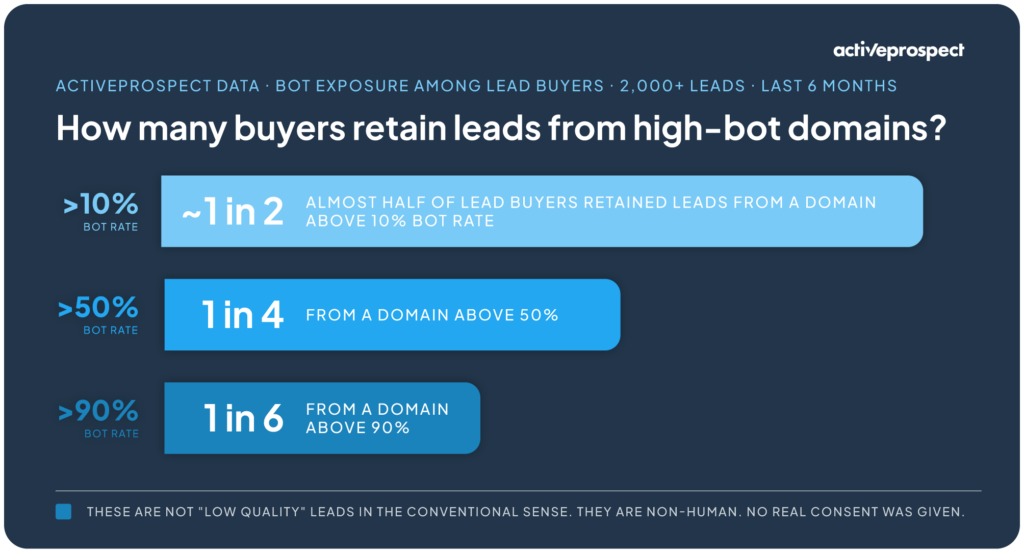
This kind of concentration matters because these leads are not simply “low quality” in the conventional sense. They are not just hard to convert. They are non-human. And if there is no human on the other side of the interaction, there is no real consent being given.
Vertical vulnerability
High-intent verticals are especially attractive targets because the economics are stronger. Where money moves quickly, fraud tends to follow. Verticals tied to urgent consumer needs, competitive acquisition environments, or high lead values naturally create stronger incentives for automation attempts.
Fraudsters do not need to attack every corner of the ecosystem equally. They go where the returns are highest and where detection gaps are easiest to exploit.
The challenge extends beyond the tools many buyers use today
Bot detection is not simply a matter of whether buyers are paying attention to fraud. In many cases, the challenge comes from the tools themselves. Many lead buying systems were built to support attribution, manage volume, route leads quickly, and measure performance.
Those functions are still essential. They help teams scale acquisition and move leads efficiently through the funnel. But bot detection often requires a different set of signals than traditional lead buying systems were designed to capture.
This challenge is especially significant in third-party lead buying. One of the most effective ways to detect bot activity is to place a detection script directly on the website where the lead is generated. That script can observe behavioral signals during the form-fill experience, such as interaction patterns, timing, device activity, and other indicators that may not be visible from lead data alone.
But lead buyers typically do not control the websites where third-party leads are generated. They cannot install a detection script on someone else’s landing page. As a result, they may be forced to evaluate fraud risk only after the lead has already been submitted, when many of the most valuable behavioral signals are no longer available.
That gap matters because bot activity is not always obvious from lead fields alone. A lead may appear valid on the surface while still showing signs of automation, form replay, repetitive submission behavior, or non-human interaction.
When those signals are not captured at the point of creation, bot-generated leads can pass through standard buying, routing, and follow-up workflows alongside legitimate leads.
Explore some of the best bot detection tools available today.
Transparency as a starting point
Before focusing on technical solutions, it is useful to identify the operating principle behind them: Transparency.
Greater transparency gives buyers and sellers a clearer way to evaluate traffic quality using shared evidence. It creates a more structured basis for accountability and makes it easier to review source quality without relying only on assumptions or isolated examples.
This can support several important outcomes:
- Source-level accountability
- Faster optimization
- Clearer buyer-seller communication
When buyers can identify which sources are associated with suspicious activity, they can make more informed decisions about purchasing and routing. When sellers can validate the legitimacy of their traffic, they have a clearer way to demonstrate quality. When both sides are working from the same signals, conversations about performance and quality can become more specific and more actionable.
In that sense, visibility helps create the conditions for stronger decision-making across the market.
You can’t optimize what you can’t see
Bot traffic can become costly in part because it is not always visible at the moment decisions are made.
In many workflows, meaningful bot signals do not appear until after leads have already entered the CRM, been routed to the Sales team, or affected reporting. By that point, lead spend has already occurred, operational resources may already have been used, and the data may already be influencing performance analysis.
That is why earlier visibility can be useful.
When buyers can identify bot-related signals before leads move into downstream systems, they have more opportunities to adjust before additional costs accumulate. Sellers can also use that visibility to demonstrate traffic legitimacy with more specificity. In that context, bot activity becomes easier to measure, monitor, and address over time.
That shift matters because optimization depends on visibility into the factors affecting performance.
Final takeaways
Bot fraud is no longer just a visible disruption, it is often a quiet, ongoing drain on lead buying performance. Even a small percentage of non-human leads can translate into significant wasted spend, polluted data, and flawed decision-making at scale.
The real challenge is not just stopping fraud, but seeing it clearly enough to measure, manage, and reduce it before it spreads downstream. With the right transparency and tools in place, buyers can make smarter investments, sellers can better demonstrate lead legitimacy, and both sides can build stronger, more accountable partnerships.