
How to set up TrustedForm to retain Facebook lead ads Certificates
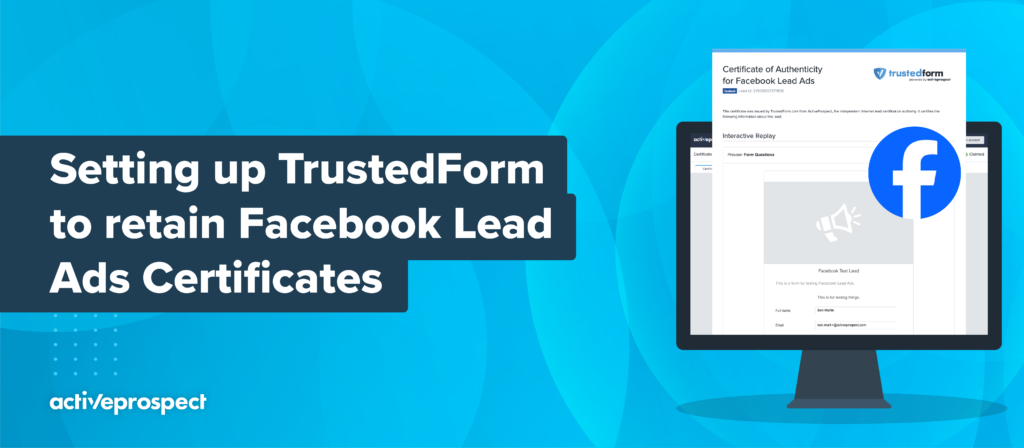
Many marketers using TrustedForm are surprised to learn that they can also use it with Facebook Lead Ads. In addition to helping verify web leads, TrustedForm can generate certificates that document consent for every lead submitted through a Facebook lead form.
This matters because Facebook Lead Ads collect personal information directly inside the Facebook platform. If you plan to contact those leads by phone or text, you may need to prove that the person gave clear permission to be contacted. Regulations such as the Telephone Consumer Protection Act (TCPA) require businesses to maintain records showing when and how consent was obtained. Without that proof, companies risk complaints, blocked campaigns, fines, or even legal action.
A TrustedForm Certificate provides a record of the user’s interaction with your Facebook lead form. The certificate captures key details such as the Lead ID, submission time, Facebook Page and Form IDs, campaign information, and an interactive replay of the form experience. This gives you a verifiable record showing what the user saw and submitted at the time of opt-in.
Because Facebook does not allow third-party scripts on its platform, the TrustedForm certificate is generated using the information Facebook provides about the lead submission. The certificate recreates the user’s experience and securely stores the consent record alongside your lead.
Use the instructions below to start capturing TrustedForm Certificates for your Facebook Lead Ads today and maintain documented proof of consent for every lead you receive.
TL;DR
• Facebook Lead Ads can generate marketing leads quickly, but TCPA rules still require businesses to capture and retain prior express written consent before contacting consumers by phone or SMS.
• Consent collected inside Facebook forms may not provide sufficient documentation to defend against TCPA complaints, regulatory scrutiny, or class action litigation.
• Businesses must maintain clear consent disclosures, submission timestamps, and verifiable records showing what the consumer agreed to at the time of opt-in.
• TrustedForm Facebook Lead Ads Certificates create an auditable record of the lead submission, including form replay and campaign metadata.
What is Facebook Lead Ads consent?
When a user submits their information through a Facebook lead ad, they are effectively giving a business permission to contact them. This consent is especially important when the communication that follows includes calls, texts, or emails for marketing purposes. According to laws like the TCPA, this type of outreach requires prior express written consent from the consumer.
Facebook lead ads include a customizable disclosure section, where businesses can present their privacy policy and consent language (e.g., agreeing to receive marketing communications via autodialer or prerecorded messages). The problem is: just having the form and disclosure visible isn’t always enough.
Why is it important to document Facebook lead ads consent?
Under the TCPA, verbal or assumed consent isn’t enough. You need proof that:
- The user saw the consent language.
- They agreed to it at the moment of submitting their information.
- The consent language met regulatory standards (e.g., clear and conspicuous).
Why Facebook lead ads consent isn’t enough
At first glance, Facebook Lead Ads appear to capture consent because users submit their information through a built-in form. However, relying on Facebook’s default lead data alone may not provide the level of documentation required for TCPA compliance.
Businesses that contact leads by phone or text must be able to demonstrate when consent was given, what disclosures were shown, and what the user actually agreed to at the time of submission. Without a verifiable record of that interaction, it can be difficult to defend against complaints, disputes, or regulatory scrutiny.
That’s where TrustedForm comes in and here is how to set it up.
Getting started
First things first: We need to make sure you have all the prerequisites necessary to successfully use TrustedForm to retain Facebook lead ads Certificates. These prerequisites include:
- Sign up for a LeadConduit and TrustedForm account to get started with TrustedForm for Facebook.
- Connect an active Facebook Page to LeadConduit.
- Use LeadConduit’s TrustedForm add-on to retain Facebook Certificates.
The TrustedForm for Facebook lead ads certificate
TrustedForm for Facebook lead ads issues a unique certificate of authenticity for each lead generated on Facebook and submitted to LeadConduit.
The certificate exposes the following information about the Facebook lead:
- Facebook Lead ID
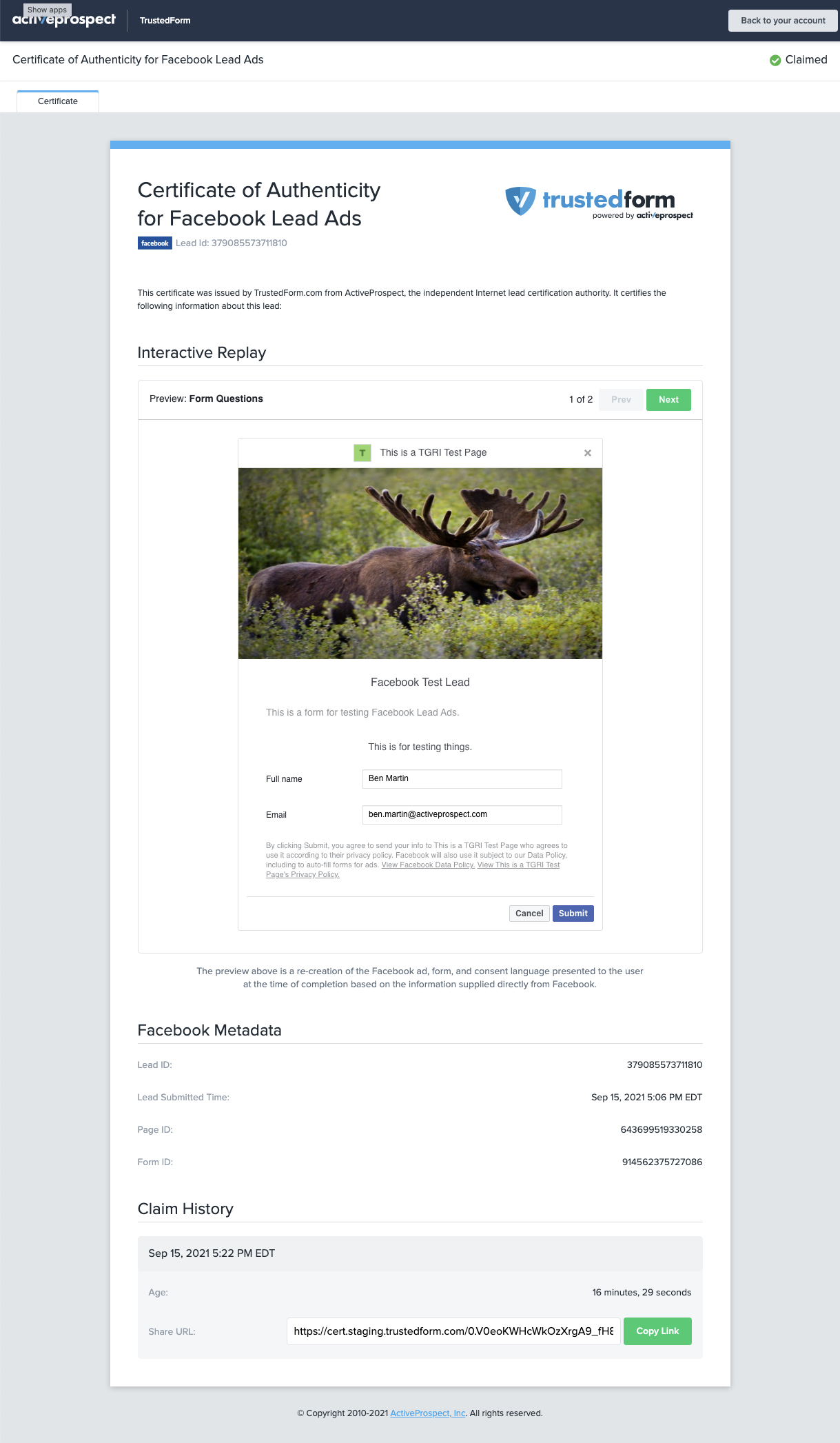
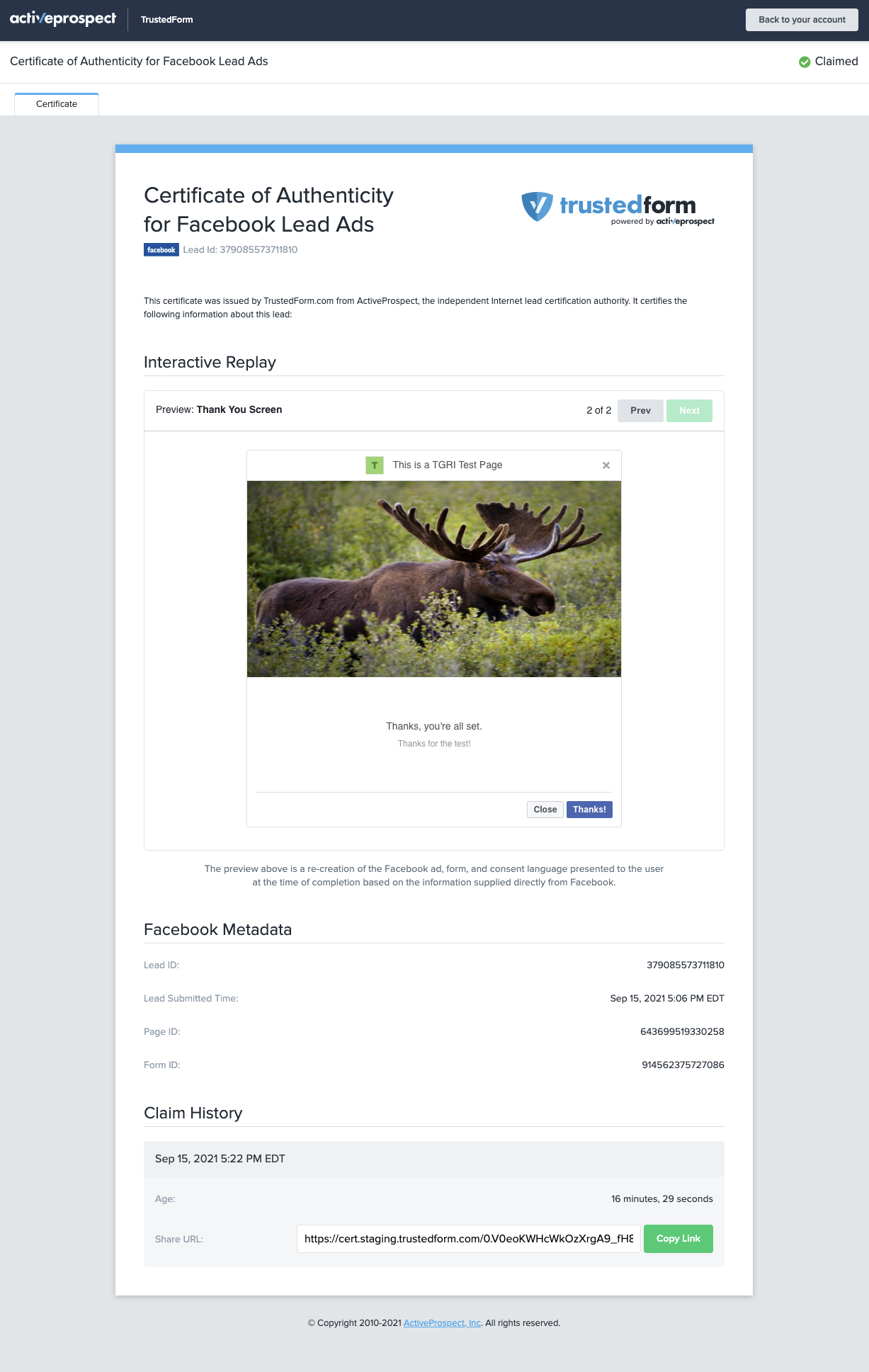
- A multi-page recreation of the Facebook ad, form, data collected, and consent language
- Lead Submitted Timestamp
- Facebook Page ID
- Facebook Form ID
- Facebook Ad Set
- Facebook Campaign
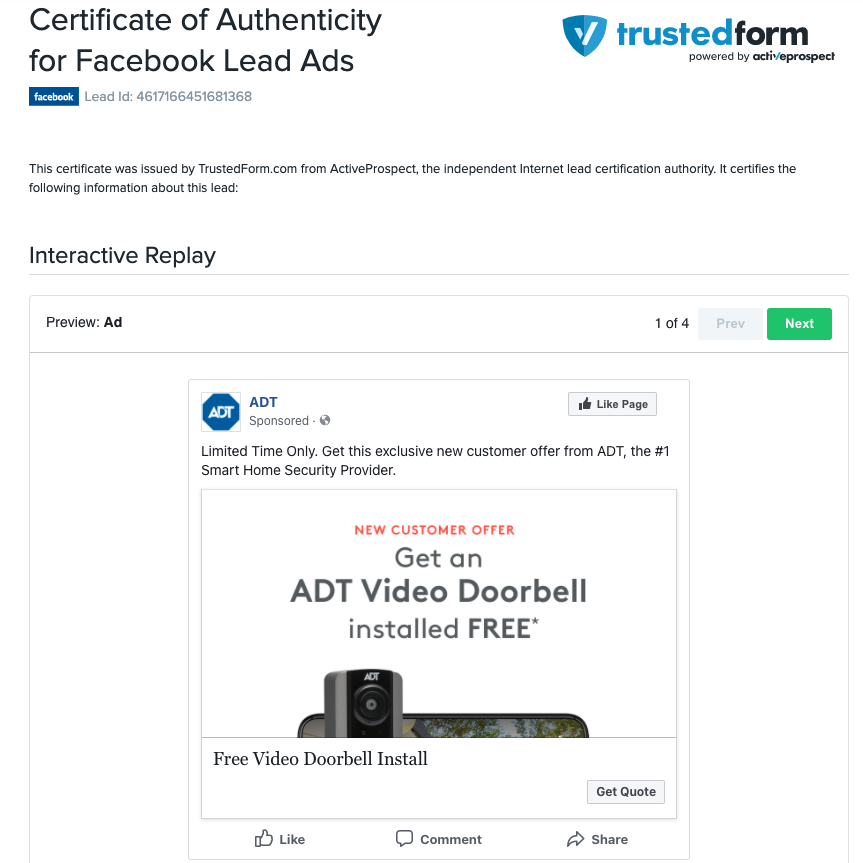
Sample TrustedForm Facebook Certificate: Ad
Here is what a typical certificate looks like:
Sample TrustedForm Facebook Certificate: Form
Here’s what a certificate for a form fill looks like:
Sample TrustedForm Facebook Certificate: Thank you page
Here’s what the “thank you for the form fill” page looks like:
What is Facebook lead ads consent?
When a user submits their information through a Facebook lead ad, they are effectively giving a business permission to contact them. This consent is especially important when the communication that follows includes calls, texts, or emails for marketing purposes. According to laws like the Telephone Consumer Protection Act (TCPA), this type of outreach requires prior express written consent from the consumer.
Facebook lead ads include a customizable disclosure section, where businesses can present their privacy policy and consent language (e.g., agreeing to receive marketing communications via autodialer or prerecorded messages). The problem is: just having the form and disclosure visible isn’t always enough.
Why is it important to document Facebook lead ads consent?
Under the TCPA, verbal or assumed consent isn’t enough. You need proof that:
- The user saw the consent language.
- They agreed to it at the moment of submitting their information.
- The consent language met regulatory standards (e.g., clear and conspicuous).
That’s where TrustedForm comes in.
How TrustedForm helps
TrustedForm captures a session replay and a certificate of the user’s interaction with the lead form. Specifically for Facebook lead ads, it allows you to:
- Prove consent was presented clearly and legibly.
- Verify the exact moment the form was submitted.
- Document the source and metadata of the lead.
- Show your compliance if you ever face a regulatory inquiry or lawsuit.
This is critical for lead buyers, marketers, and advertisers who rely on third-party lead sources or run high-volume campaigns. Without proper documentation, you risk hefty fines or legal disputes – even if the consumer originally gave their consent.
Bottom line: Facebook lead ads make it easy to generate leads, but TrustedForm makes sure those leads are compliant, authentic, and high quality.

Differences between TrustedForm Certificates and TrustedForm for Facebook lead ads Certificates
Facebook does not allow third-party scripts to be added to any Facebook property, so TrustedForm for Facebook lead ads Certificates do not contain the following fields:
- The URL of the page that hosts the offer form
- The URL of the framing page, if the form was framed
- The consumer’s public IP address
- The consumer’s browser version
- The consumer’s operating system
- A full snapshot of the HTML, images, CSS and other page assets of the offer form as seen by the consumer in the form of a video replay. The certificate does include a multi-page recreation of the Facebook version of the ad.
Additionally, TrustedForm for Facebook lead ads does not support masked certificates or the flagging of sensitive data fields.
Benefits of retaining TrustedForm for Facebook lead ads Certificates
Retaining certificates gives you the following benefits:
- The ability to verify the authenticity of a certificate. Capture and deliver all appended fields that come with the certificate
- The ability to store the certificate, including the appended fields and multi-page recreation, in the account
- Programmatic page scanning and fingerprinting
- Access to the share URL, allowing others to view your certificate.
A note for existing TrustedForm clients
If you are using an existing TrustedForm step in LeadConduit, please be aware that TrustedForm for Facebook Lead Ads does not support filtering with GeoIP data, masked certificates, or several other features of a standard web lead TrustedForm certificate. You can exempt TrustedForm for Facebook Lead Ads from this type of filtering by adding a nested rule, exempting the Facebook Lead Ads source.

Be sure to store the certificate URL in your CRM with your Lead Ads lead data so you can easily access it in the future!
FAQs
1. TCPA in advertising: Is compliance still required if I’m running Facebook lead ads?
Yes. Using Facebook Lead Ads does not remove the responsibility to follow TCPA advertising requirements. If you contact leads by phone or text message, you must be able to show that the person gave prior express written consent to be contacted. Even though Facebook collects the lead information, the advertiser is still responsible for keeping records that show when consent was given and what disclosures the user saw at the time of submission.
2. How do I prove consent for Facebook lead ads?
To prove consent, you need a record of the lead’s submission that includes the consent language, the time the lead was submitted, and the details of the form the user interacted with. Many marketers store a consent record alongside each lead in their CRM so it can be referenced later if a complaint or dispute occurs.
Tools like TrustedForm create a certificate that captures and preserves these details so you have documented proof of the lead’s opt-in.
3. What is a TrustedForm Facebook lead ads certificate?
A TrustedForm Facebook Lead Ads certificate is a record that documents the lead submission and the consent experience. It includes details such as the Facebook Lead ID, submission time, page and form identifiers, campaign information, and a replay of the form interaction. The certificate is stored as a URL alongside the lead in your CRM, allowing you to review or share the consent record whenever needed.
Conclusion
Setting up TrustedForm to retain Facebook lead ads certificates is a powerful way to enhance your compliance, verify consent, and confidently manage your lead data. While the certificates differ slightly from those generated on web properties, they still provide essential proof of opt-in and a clear snapshot of the user’s interaction with your ad.
With just a few simple setup steps through LeadConduit, you can start capturing and storing these certificates automatically – giving your team peace of mind and your CRM a robust compliance trail. Ready to take control of your Facebook leads? Book a free demo to see how to get started.